

Managing Large Numbers of Water Meters and Public Transport
Smart water meter management - Mönchengladbach, Germany
The Challenge
Niederrhein Energie und Wasser (NEW) supplies electricity, gas, water and heat to homes and businesses across the Lower Rhine region in Germany, alongside local public transport. Serving hundreds of thousands of residential and commercial customers means the company runs several distinct infrastructures at once, each with its own monitoring needs and its own failure modes. A leaking water meter and a bus that’s parked in the wrong bay are unrelated problems, but both need to be visible from the same operational picture if a small team is going to catch them in time.
Logging and Monitoring
NEW wanted a single platform to bring these different domains together, starting with two concrete use cases: logging and monitoring water meters across its network, and tracking which bus was parked in which spot at the depot. The water meter rollout alone meant connecting over 50,000 devices, all reporting over NEW’s existing LoRaWAN network. That scale was the real test. Most IoT platforms are built and tuned for hundred thousand assets; NEW needed one that stayed fast and usable way beyond that.
Scaling to 50,000 With LoRaWAN
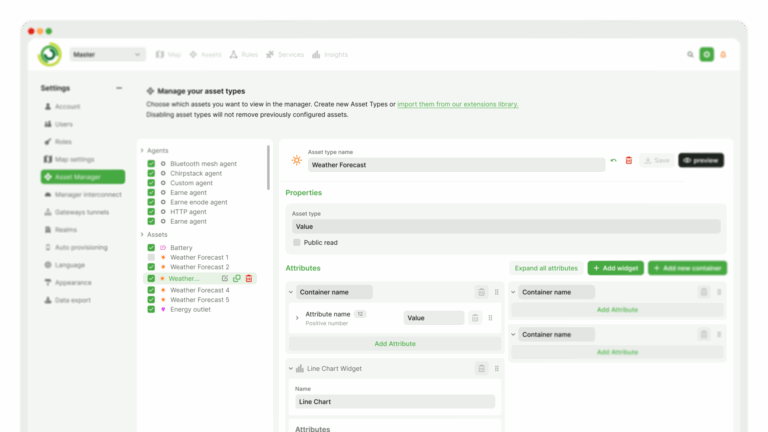
OpenRemote integrates directly with NEW’s LoRaWAN (ChirpStack and The Things Stack) infrastructure, so meter readings and depot sensor data flow into the Manager without a separate ingestion layer to maintain. Every water meter and every depot parking spot is modelled as an asset, giving NEW’s team one consistent way to see live values, history and alerts regardless of which domain they’re looking at.
Getting there took real engineering work on our side. OpenRemote wasn’t originally built with a single deployment holding 50,000+ assets in mind, so onboarding NEW meant revisiting core parts of the platform’s architecture: how assets are indexed, queried and rendered at that volume, without slowing down for smaller deployments running the same codebase. It’s the kind of change that doesn’t show up in a feature list but decides whether a platform can actually carry an enterprise utility’s full asset base
Chasing Down a Problem on the Map
We reworked how the map handles this scale. With tens of thousands of points on screen, a static view stops being useful the moment something goes wrong. NEW’s team can now build their own filters directly on the map, isolating a specific meter type, a fault status, or a depot zone, so a technician chasing down a problem sees only what’s relevant rather than scrolling through a dense cluster of assets. That shift, from a fixed map to one operators can shape themselves, has made day to day diagnosis noticeably faster.
Results
NEW now runs its water meter network and bus depot tracking on the OpenRemote platform, with room to bring further domains onto it as needed. The architecture changes we made for this deployment now benefit every OpenRemote installation working at scale. ChirpStack and The Things Stack Integration with auto discovery and device provisioning, as well as the configurable map filters are now a standard part of our toolkit.
Smart City and Mobility
Managing digital assets in a city can become complex for the responsible departments, whether parking manager, lighting manager, security, or the maintenance department.
The OpenRemote IoT Platform connects and controls different vertical systems, using configurable protocol agents or its Edge Gateway. More importantly, alerts are set to monitor optimal performance as well as unexpected behaviour. Notifications are send to professionals and systems are activated.
A dashboard for a domain manager and mobile apps for staff on the ground. All tailored to your specific context and identity, hosted in your own secure environment.