






OpenRemote Presents at NASA Conference About Reliability in Generative AI
Jun 3, 2026 | Blog, Industry Insights, Media, Press
How do you know whether AI-generated code does precisely what you ask, before deploying the code in high-risk environments? OpenRemote member Panos proposes how
Panagiotis (Panos) Kalogeropoulos, one of the OpenRemote core contributors and a member of the team, is currently a Master’s Student at Fontys University of Applied Sciences, where he is performing research on making generative AI, like LLMs, more reliable in high-risk environments, like medicare, the semiconductor industry, etc.
His research paper, “Evaluating Generative AI Outputs as a Human-Machine Interface Between Domain Experts and Domain-Specific Languages: A Cost-of-Error Framework”, was accepted for presentation at the Formal Requirements Engineering and Artificial Intelligence (RExAI) workshop of The NASA Formal Methods Symposium 2026, organized by the NASA Jet Propulsion Laboratory, at the University of Southern California campus, in Los Angeles, California.
“Companies that own very expensive and/or dangerous equipment want to reap the benefits of Artificial Intelligence, whilst not putting human lives, or the safety of the equipment, in the hands of an LLM that cannot be trusted,” says Panos. “You cannot trust any arbitrary LLM output. You must be able to verify whether AI does what you think it does.”
The research presents a way for domain experts who are not technical enough to review o r write code, to judge whether AI-generated code is safe to deploy in high-risk environments. It does so by utilizing a panel of specialized “judge” models scoring the code generated across dimensions/perspectives (backend, security, compliance, etc.) and translating that into a monetary risk estimate before anything goes live.
Panos used OpenRemote as the testbed for his theory; using the open-source backbone of the platform, he was able to devise an entire testing apparatus for his work, fully based on OpenRemote. OpenRemote’s public GitHub issues were used to generate solutions to them using MermaidJS sequence diagrams, and those diagrams were graded on different product owner/stakeholder perspectives, like databases, frontend, and legal.
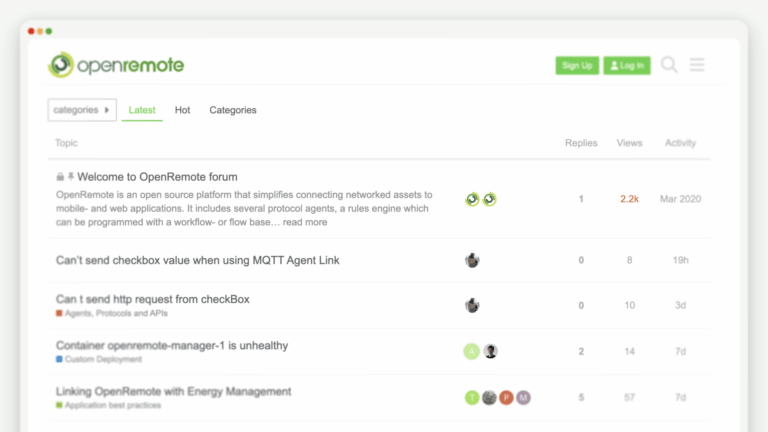
“OpenRemote can easily be used for performing research in the topic of software engineering and IoT; the platform has been designed from the ground up to be flexible, auditable, generalizable, and easily configurable. The public forums, our documentation, and our Github issue corpus offers a fully featured software product under a permissive license and with no fees at all, giving me a great base on which I can work on my translation tool”, says Kalogeropoulos.
As we are moving into a new age of Artificial Intelligence and Machine Learning, the way we work is fundamentally changing, even in high-risk industries and environments. Organisations that find themselves in these environments want to equally reap the benefits of Generative AI, and it’s pivotal to accelerate research on generating durable, safe, and reliable outputs from LLMs. That is the type of research that OpenRemote tries to support, to put itself in the forefront of emerging technologies.
While Panos presented about his work with Generative AI, the conference focused heavily on rigorous solutions to Aeronautics and Avionics’ most difficult theorems. The most memorable moment for Panos was a talk about the history of NASA’s Formal Methods group, the organizers behind the conference. This group has existed since the 1990s and has been part of various important missions. “As an aviation person, I was excited to find out that the Formal Methods group formally verified the Traffic Alert and Collision Avoidance System version 2 (TCAS v2), which is now in use by effectively every aircraft currently in the skies around the world.” The TCAS system allows planes to autonomously avoid mid-air collisions by communicating with each other in the air.
Panos had the opportunity to talk about his research with academics from around the world that are focusing on formal verification and validation and AI, but also from industry experts from Amazon, RTX, Boeing, Airbus, and other organizations. Panos has used this opportunity to refine his research and reflections on how OpenRemote should embrace AI integrations in a manner that users can trust using it.